AI vs AGI vs Quantum Computing: Three Different Futures of Technology

Nutz
2026-11-05
Confused by tech jargon? We explain the fundamental differences between Artificial Intelligence (AI), Artificial General Intelligence (AGI), and Quantum Computing.
If you read the news today, it sounds like Artificial Intelligence (AI), Artificial General Intelligence (AGI), and Quantum Computing are all racing toward the same finish line.
This creates massive confusion. These are not three competing versions of the same technology. They are entirely different concepts belonging to different domains of computer science and physics.
To understand the future of technology, we must eliminate the hype and define exactly what these three terms mean, what problems they solve, and how they might eventually interact.
The Core Definitions
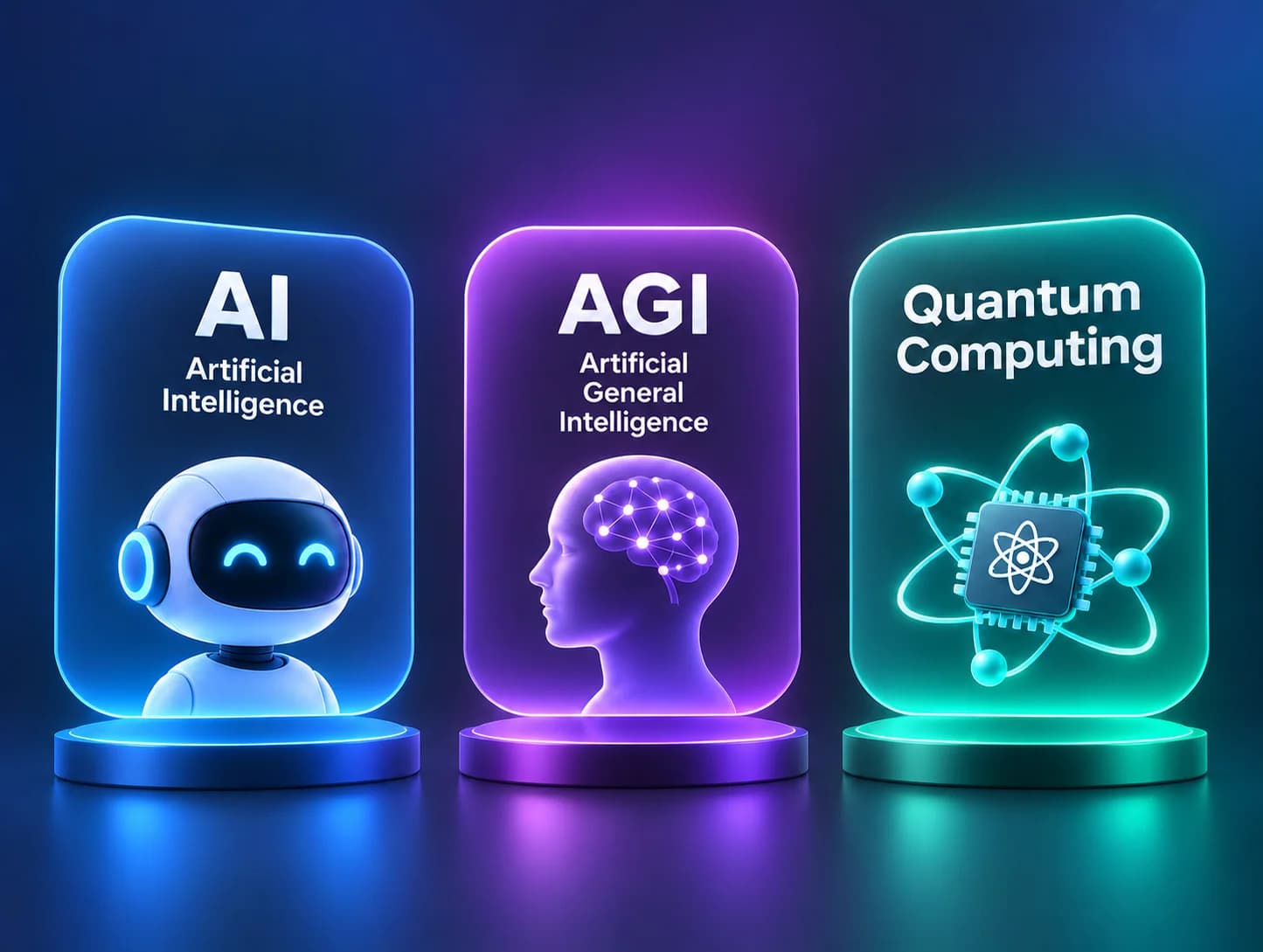
AI (Artificial Intelligence): A broad field of computer science focused on creating systems capable of performing tasks that typically require human intelligence (e.g., translating languages, recognizing images, or generating text).
AGI (Artificial General Intelligence): A hypothetical, future state of AI where a machine can understand, learn, and apply intelligence across any cognitive task at a level equal to or better than a human.
Quantum Computing: A fundamentally different paradigm of physical computing hardware that uses the principles of quantum mechanics (superposition and entanglement) to process information in ways classical computers cannot.
A Practical Comparison
| Feature | Artificial Intelligence (AI) | Artificial General Intelligence (AGI) | Quantum Computing |
|---|---|---|---|
| What it is | Applied machine learning (Software) | Hypothetical generalized intelligence | A new physics-based hardware paradigm |
| Current State | Highly advanced and commercially deployed | Does not exist (theoretical) | In early experimental stages |
| Core Hardware | GPUs, TPUs, Classical silicon chips | Unknown (likely massive classical compute) | Qubits operating at sub-zero temperatures |
| Typical Applications | ChatGPT, medical image scanning, self-driving cars | N/A | Breaking encryption, discovering new drugs/materials |
| Limitations | Highly specialized; lacks true reasoning or understanding | The definition of “general” is widely contested | Extreme error rates; requires near absolute-zero cooling |
Diving Deeper: Where Are We Now?
The State of AI
We are currently in the era of “Narrow AI.” Large Language Models (LLMs) like ChatGPT or decision models like Jev are incredibly powerful, but they are specialized. An AI that can write beautiful poetry cannot drive a car, and an AI that can play chess cannot summarize a legal contract. AI today relies on recognizing deep patterns in massive amounts of training data.
The Problem with AGI
AGI is not a specific software program; it is a conceptual threshold. The industry cannot agree on when AGI will be achieved because there is no universally accepted test for “general intelligence.” Does AGI need consciousness? Does it need to be able to learn a new task with zero training data? AGI remains a philosophical and technical goal, surrounded by immense hype and speculation.
The Reality of Quantum Computing
While AI is a software advancement running on classical computers (which process data as 1s and 0s), Quantum Computing rewrites the hardware rules. Quantum computers use “qubits,” which can exist as 1, 0, or both simultaneously (superposition).
Quantum computers are not simply “faster computers.” They will be terrible at running your web browser or playing a video game. However, they are theoretically capable of solving specific mathematical problems (like simulating molecular bonds for drug discovery or factoring massive prime numbers for cryptography) in minutes, which would take classical supercomputers millions of years.
How Will These Technologies Interact?
Can Quantum Computers Run AI?
In theory, yes, through an emerging field called Quantum Machine Learning. Quantum computers could potentially process complex AI training datasets much faster than classical GPUs. However, quantum hardware is currently too noisy and error-prone to run the massive neural networks we use today.
Can AI Help Build Quantum Computers?
Yes. Researchers are already using classical AI to help design better quantum circuits and develop error-correction algorithms, which is the biggest hurdle in quantum hardware right now.
Could AGI Run on Quantum Computers?
This is purely science fiction for now. It remains an open technical question whether AGI will require the unique processing capabilities of quantum mechanics, or if it can be achieved simply by scaling up classical silicon GPUs.
Three Possible Technology Stacks of the Future
As we look toward the 2030s, we are likely looking at tiered computing stacks:
Stack 1: Classical Computing + AI
Your laptop and smartphone will use specialized, local AI models (running on standard silicon chips) to automate daily tasks, draft emails, and organize data.
Stack 2: Cloud Data Centers + AI Agents
Massive cloud server farms packed with GPUs will run complex networks of AI agents handling business operations, video generation, and heavy analytical reasoning.
Stack 3: Quantum Accelerators + AI
For humanity's hardest problems—like designing a new battery material or curing a disease—classical supercomputers will use AI to route specific, highly complex mathematical equations to a Quantum Accelerator for instant solving.
AI, AGI, and Quantum Computing are not competitors. They are separate vectors of innovation that may one day merge to redefine what technology is capable of achieving.
Related work
View Clotricks web app case studyAbout the Author
Nutz
Design & Development Team
We share insights on design, development and building digital products from our studio in Erode, Tamil Nadu.
Work with usRelated SaaS product
Built by Nutz in Erode
Explore SaaS products we design and ship.