AI Coding Assistants: How AI is Changing Software Development

Nutz
2026-10-17
The era of typing every line of code is over. Learn how AI coding assistants like Claude, ChatGPT, GitHub Copilot, and Cursor are transforming software engineering.
Five years ago, a software developer's primary workflow involved writing logic manually and spending hours searching Stack Overflow for the solution to a cryptic error message.
Today, the entire paradigm of software engineering has shifted. The introduction of Large Language Models (LLMs) has turned programming from an act of "typing syntax" into an act of "architectural direction."
If your engineering team or development agency is not deeply integrated with AI coding assistants, they are operating at a massive competitive disadvantage. Here is a look at the landscape of AI coding tools, how they are used in production, and what it means for the future of building software.
The Evolution: From Chatbots to Integrated IDEs
Initially, developers used AI like a glorified search engine. They would open a browser, paste an error message into ChatGPT, copy the suggested fix, and paste it back into their code editor.
This "copy-paste" era is already obsolete.
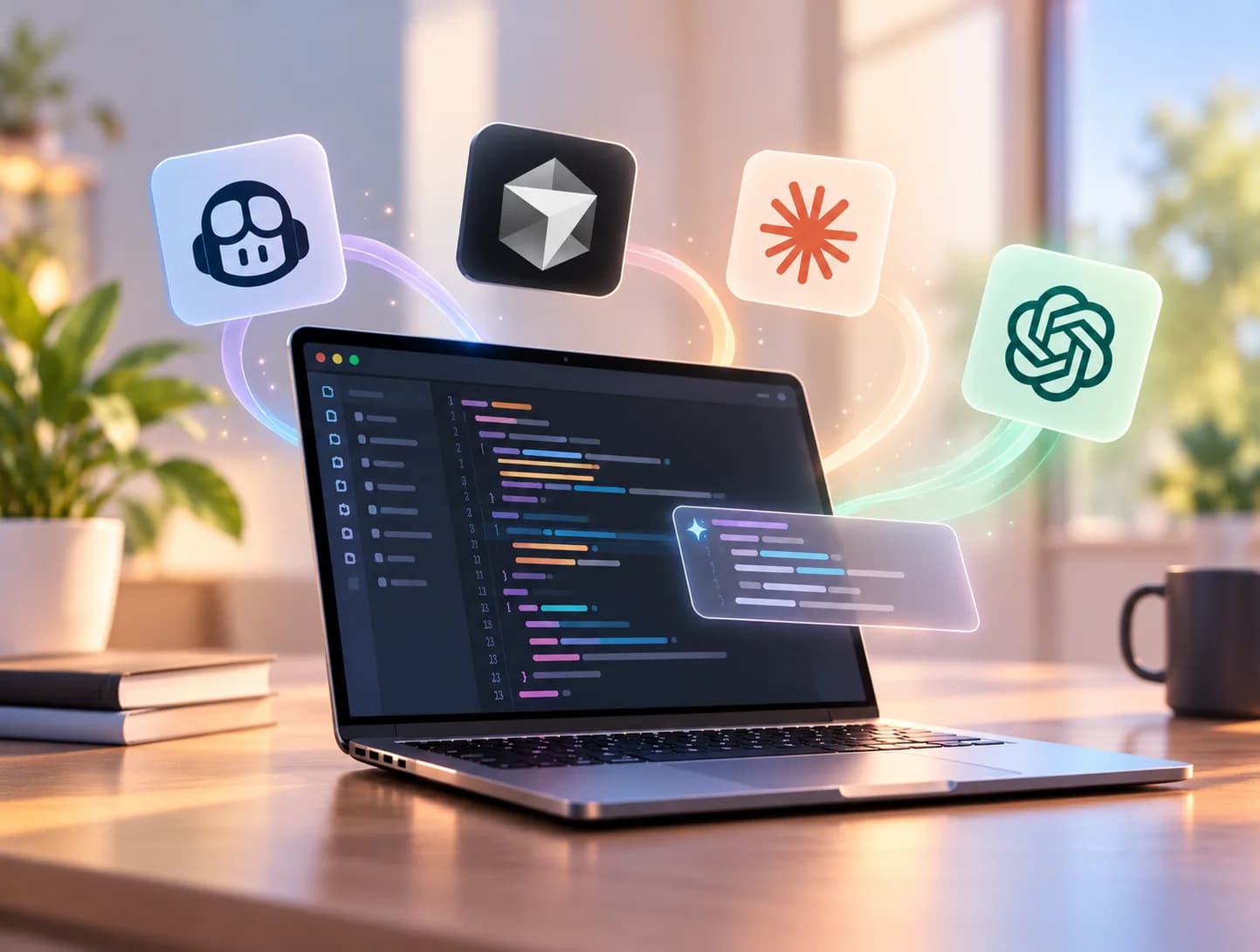
Today, AI lives directly inside the Integrated Development Environment (IDE).
1. GitHub Copilot (The Autocomplete Engine)
GitHub Copilot was the first massive breakthrough. It acts as an incredibly advanced autocomplete. As a developer types the name of a function (e.g., calculateGST()), Copilot reads the surrounding code and instantly generates the entire mathematical logic in gray text. The developer hits "Tab" to accept it. It saves developers from typing boilerplate code, increasing typing speed by over 30%.
2. Cursor (The AI-First Editor)
Cursor is currently the most disruptive tool in the engineering world. It is a fork of VS Code, but built from the ground up for AI.
Instead of just autocompleting lines, Cursor can understand your entire codebase. A developer can press Cmd+K and type: "Find the authentication bug causing the login to fail on mobile, and rewrite the token logic to use HTTP-only cookies."
Cursor will scan 50 different files, find the exact routing logic, generate the fix across multiple files simultaneously, and allow the developer to review the diff before applying it.
The Battle of the Models: Claude vs. GPT-4
The IDEs (like Cursor) are the vehicles, but the LLMs are the engines. Developers can choose which engine to use.
Currently, Claude 3.5 Sonnet (by Anthropic) is widely regarded as the most capable coding model for modern web development (React, Next.js, TypeScript). It possesses a remarkable ability to hold massive architectural context in its memory and writes highly elegant UI code.
GPT-4o (by OpenAI) remains incredibly powerful, particularly for heavy backend logic, Python data processing, and complex algorithmic debugging.
Elite developers constantly switch between the two models depending on the specific task they are executing.
What AI Coding Means for Businesses
The integration of AI into software development changes the economics of building applications for businesses.
- Speed to Market: Features that used to take an engineering team two weeks to build (such as implementing a complex drag-and-drop dashboard) can now often be architected and deployed in three days.
- The Rise of the "10x Architect": AI does not replace senior engineers; it gives them superpowers. A senior engineer no longer spends time fixing missing semicolons. They spend 100% of their time on system architecture, security, and business logic, while the AI types the syntax.
- The Danger for Juniors: Junior developers who rely entirely on AI to write code without understanding why the code works become a liability. When the AI hallucinates a subtle security flaw, a developer who doesn't understand the underlying concepts cannot fix it.
The Future: Autonomous Coding Agents
We are moving towards an era of "Agentic Coding." Soon, developers will not just ask AI to write a function. They will give an AI Agent a Jira ticket: "Build a password reset flow, update the database schema, write the unit tests, and deploy a staging environment." The AI will execute all steps autonomously, asking the human only for final code review.
At Nutz, our engineering teams leverage the most advanced AI coding workflows—including Cursor, Claude, and Copilot—to build secure, highly complex custom software and enterprise platforms at unprecedented speed.
Related work
View Clotricks web app case studyAbout the Author
Nutz
Design & Development Team
We share insights on design, development and building digital products from our studio in Erode, Tamil Nadu.
Work with usRelated SaaS product
Built by Nutz in Erode
Explore SaaS products we design and ship.