Why are successful Indian brands moving away from Amazon and building custom D2C websites? Discover the power of customer data, brand control, and high profit margins.
Look at the most successful modern consumer brands in India—from premium coffee roasters to disruptive cosmetic companies and high-end streetwear labels. While many of them list a few products on Amazon or Myntra, their primary focus, marketing budget, and strategic energy are entirely dedicated to their own independent e-commerce websites.
Why go through the massive hassle of building software, integrating payment gateways, and fighting for Google traffic when Amazon has millions of buyers ready to purchase right now?
The answer is simple: You cannot build a billion-dollar brand on rented land.
Here is exactly why serious D2C (Direct-to-Consumer) companies transition away from marketplaces and invest heavily in their own e-commerce platforms.
1. The Power of First-Party Data (The Ultimate Moat)
If you sell 10,000 units on Amazon, you have made money, but you have learned almost nothing. Amazon acts as an iron wall between you and the buyer. You do not get their email address, their phone number, or their browsing behavior.
When you sell 10,000 units on your own website, you acquire a highly valuable asset: First-Party Data.
- You know exactly which Facebook Ad the customer clicked.
- You know they spent 3 minutes looking at the blue variant before buying the red variant.
- Most importantly, you have their contact information.
If you launch a new product next year, you do not have to pay Mark Zuckerberg or Jeff Bezos to reach those 10,000 people. You send them an email or a WhatsApp message for fractions of a paisa. He who owns the customer data owns the future of the business.
2. Escaping the “Commodity Trap”
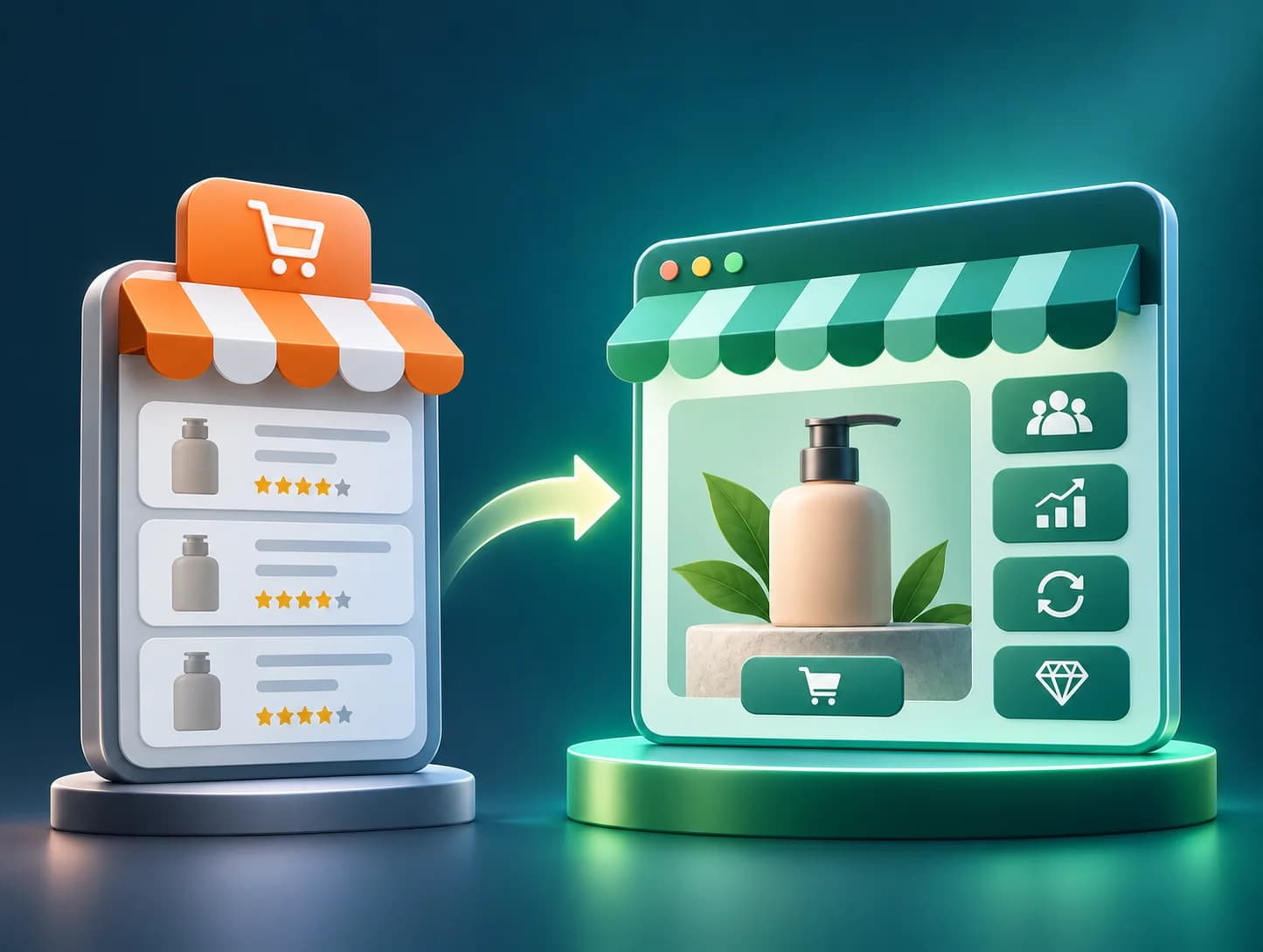
Marketplaces are designed for price comparison. If a user searches for “Vitamin C Serum” on a marketplace, your product is displayed alongside 40 identical bottles. The interface forces the user to compare solely based on price and star ratings. You are reduced to a commodity.
On your own website, the competition disappears.
When a user lands on your domain, they are immersed in your world. You can use full-screen video to explain the sourcing of your ingredients. You can highlight deep founder stories. You can build an interactive quiz to recommend the perfect product. You dictate the narrative, which allows you to charge a premium price based on brand value, not just undercut the cheapest competitor.
3. Increasing Customer Lifetime Value (LTV)
D2C economics rely on repeat purchases. If you pay ₹500 in marketing to acquire a customer who buys a ₹1,000 product, your margin is incredibly tight. But if that customer returns to buy from you four more times over the next two years, the business becomes wildly profitable.
An owned website allows for complex retention strategies that marketplaces forbid:
- Subscription Models: Offering “Subscribe and Save” for monthly coffee deliveries.
- Loyalty Programs: Giving points for every purchase that can be redeemed for exclusive merchandise.
- Upselling: Offering a highly relevant, discounted accessory the exact moment they hit the checkout button.
4. Company Valuations and IP
Investors look at businesses very differently than founders do.
If an investor looks at a business generating ₹10 Crores entirely on Amazon, they see a highly fragile company. If Amazon changes its algorithm or suspends the account, the company is worth zero.
If an investor looks at a business generating ₹10 Crores on a custom-built website with a database of 100,000 verified customer emails, they see a highly resilient, defensible asset. D2C brands that own their sales channels and customer data receive significantly higher valuation multiples during funding rounds or acquisitions.
The Bottom Line
Marketplaces are phenomenal for distribution and initial validation. But they are distributors, not brand builders.
If your goal is simply to move inventory and make a quick margin, stick to the marketplaces. If your goal is to build a generational brand, foster deep customer loyalty, and command premium valuations, you must eventually own the digital soil upon which your store is built.
At Nutz, we empower ambitious D2C brands to take control of their destiny. We engineer fast, scalable, custom e-commerce websites and enterprise platforms that prioritize your profit margins and secure your customer data.
Related work
View Clotricks web app case studyAbout the Author

Nutz
Design & Development Team
We share insights on design, development and building digital products from our studio in Erode, Tamil Nadu.
Work with usRelated SaaS product
Built by Nutz in Erode
Explore SaaS products we design and ship.