ChatGPT for Small Businesses: Practical Use Cases for Indian SMEs

Nutz
2026-11-11
Cut through the AI hype. Discover highly practical, realistic ways Indian small businesses can actually use ChatGPT for content, support, and automation.
If you read LinkedIn or tech blogs, you might believe that ChatGPT is about to replace entire marketing teams and run companies on autopilot.
For the average Indian SME—a logistics company in Chennai, a manufacturer in Erode, or a retail chain in Mumbai—this hype is often confusing. Business owners don't want buzzwords; they want practical solutions that save time, reduce costs, or increase revenue.
Let’s cut through the noise. Here is a practical, grounded look at how small businesses in India can actually use ChatGPT today, and where the technology still falls short.
What ChatGPT Actually Is (In Business Terms)
ChatGPT is a highly advanced text-prediction engine. It has read a massive portion of the internet and is incredibly good at understanding context, summarizing information, and generating human-like text.
However, it is not a database of perfect facts. It does not “know” your specific business processes unless you provide them in the prompt.
In a business context, think of ChatGPT as a very fast, very eager junior assistant. It can draft documents, brainstorm ideas, and format data brilliantly, but its work always requires final review by a senior manager (you).
5 Practical Use Cases for Indian Businesses
Here is where Indian businesses are finding real, immediate value without requiring complex technical integrations.
1. Generating E-commerce Product Descriptions
Writing unique, SEO-friendly product descriptions for 500 different t-shirts or machinery parts is exhausting.
The Prompt: “I sell a 100% cotton blue men's polo shirt manufactured in Tirupur. Write a 100-word product description focusing on breathability and summer wear. Include 3 bullet points for features.”
The Result: Instant, professional copy ready for your website or Amazon listing.
2. Drafting Difficult Professional Communications
Whether it is a delayed shipping notice, a formal response to a negative Google review, or a polite payment reminder to a stubborn client.
The Prompt: “Write a polite but firm email to a B2B client who is 30 days late on a ₹2 Lakh payment. Offer them a chance to call me if they are facing cash flow issues, but stress that payment is required this week.”
3. Summarizing Long Documents or Tenders
Government tenders or complex vendor contracts can be 50 pages long. You can paste the text into ChatGPT (ensure you do not paste highly confidential data).
The Prompt: “Summarize the key deliverables, deadlines, and penalty clauses from this vendor agreement in a bulleted list.”
4. Creating Social Media Content Calendars
Consistency is the hardest part of social media marketing.
The Prompt: “Act as a social media manager for a modular kitchen business in Bangalore. Create a 4-week content calendar for Instagram with 3 post ideas per week. Focus on space-saving designs, material durability, and customer testimonials.”
5. Standardizing Internal SOPs (Standard Operating Procedures)
Many SMEs struggle to document how tasks are done, making hiring difficult.
The Prompt: “Create a step-by-step SOP for a retail store cashier opening the shop in the morning. Include turning on the POS system, counting the cash drawer, and checking the CCTV.”
Taking it Further: Chatbots and AI Agents
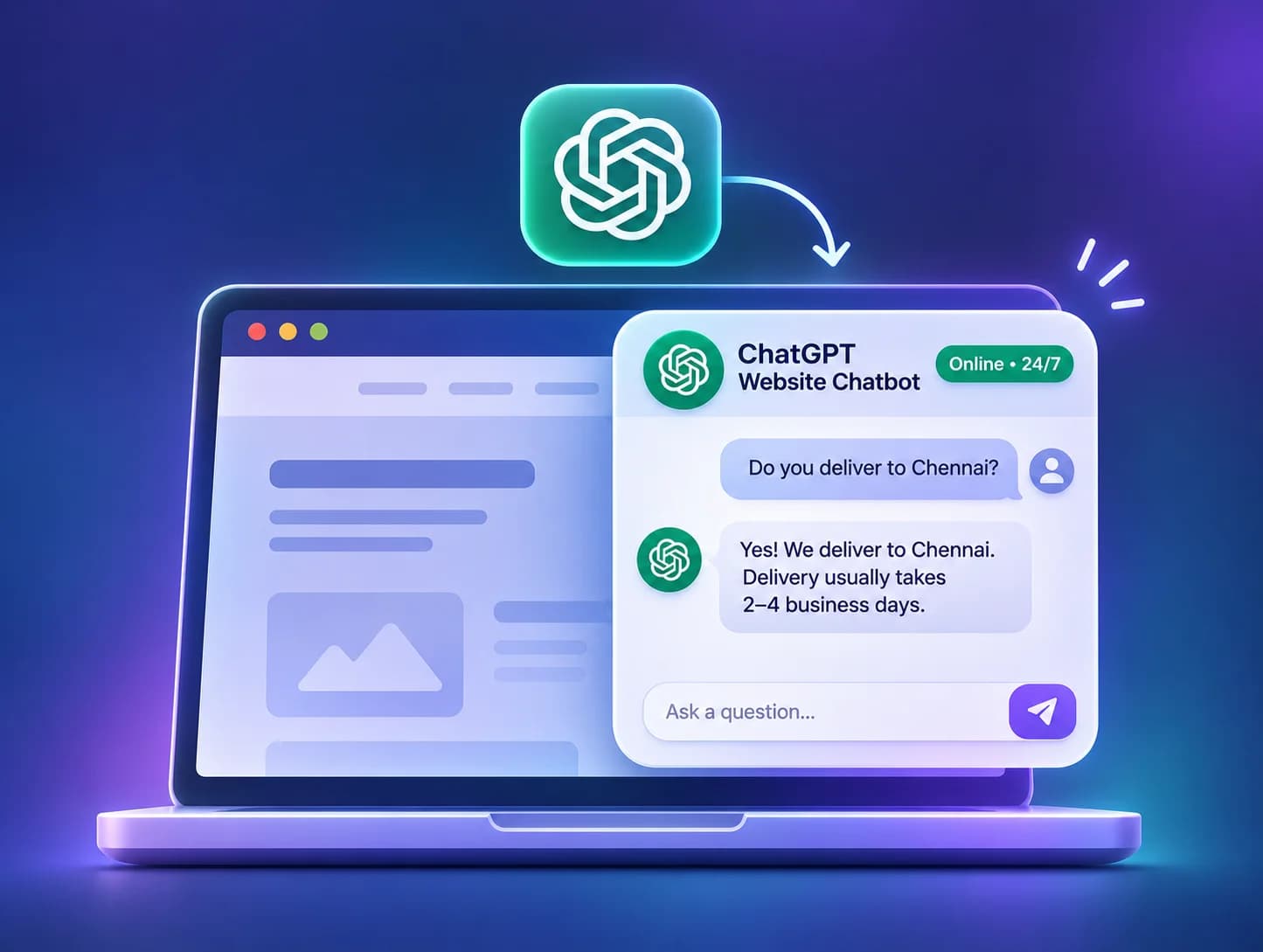
Using the ChatGPT website is great for internal workflows, but businesses eventually want to use AI to interact with customers. This involves using the OpenAI API to connect the AI to your website or WhatsApp.
AI Chatbots vs. Traditional Chatbots
Traditional chatbots (like those on many bank websites) are “deterministic.” They rely on strict button-clicks (Press 1 for Sales, Press 2 for Support). If a customer types a complex question, the bot fails.
An AI Chatbot powered by ChatGPT can have a fluid conversation. You can upload your entire product catalog and return policy into the AI's “brain.” When a customer asks on WhatsApp, “Do you deliver the red chair to pincode 600001, and what happens if it arrives broken?” the AI can read the policies and generate a perfect, customized answer instantly.
The Limitations: Where AI Fails
Before integrating AI deeply into your business, be aware of the risks:
- Hallucinations: ChatGPT will confidently invent facts if it doesn't know the answer. If a customer asks an AI chatbot for a discount, the AI might invent a 50% discount code just to be helpful.
- Context Limits: ChatGPT does not automatically connect to your inventory system or CRM. Unless properly integrated by a development team, it cannot tell a customer if a specific size is currently in stock.
- Data Privacy: Never paste sensitive financial data, customer passwords, or proprietary source code into public AI tools.
The Verdict
Small businesses do not need to implement complex AI agents immediately. The best strategy is to start using the free or Plus version of ChatGPT for internal workflows—drafting emails, writing website content, and brainstorming.
Once your team is comfortable with how AI behaves, you can explore integrating custom AI chatbots into your website or WhatsApp to handle customer support.
Looking to implement AI in your business safely? Nutz helps Indian enterprises and startups build secure, customized AI integrations, automated workflows, and smart chatbots.
Related work
View Clotricks web app case studyAbout the Author
Nutz
Design & Development Team
We share insights on design, development and building digital products from our studio in Erode, Tamil Nadu.
Work with usRelated SaaS product
Built by Nutz in Erode
Explore SaaS products we design and ship.