Cloud Hosting vs VPS: Which is Best for Your Business Website?

Nutz
2026-10-09
Moving beyond shared hosting? Compare traditional VPS hosting with modern Cloud Hosting to find the most reliable, scalable infrastructure for your Indian business.
When you first launch a small business website, you usually buy cheap "Shared Hosting" (where your website shares a single server with hundreds of other random websites).
But as your business grows, and your website starts generating real revenue, Shared Hosting becomes a liability. Your site slows down, crashes during traffic spikes, and faces severe security risks.
It is time to upgrade your infrastructure. The two standard enterprise options are VPS (Virtual Private Server) and Cloud Hosting. The terminology is highly confusing, and marketing departments often use the words interchangeably. Here is a technical breakdown of the difference between the two, and which one your business actually needs.
Understanding VPS (Virtual Private Server)
A VPS is a single physical server (a massive computer in a data center) that has been digitally sliced into smaller, isolated virtual servers.
When you buy a VPS, you are renting one of those specific slices. You get guaranteed resources (e.g., 4 CPU cores and 8GB of RAM) that no other website can steal.
The Advantages of VPS:
- Predictable Cost: You pay a flat monthly fee (e.g., ₹2,000/month) regardless of your traffic.
- Total Control: You get "root access," meaning you can install custom operating systems, specialized software, and configure the firewall exactly how you want.
The Disadvantages of VPS (The Single Point of Failure):
Your website lives on one specific physical machine. If the motherboard on that physical machine burns out, your website goes completely offline until a human technician replaces the hardware. Furthermore, if you get a massive spike in traffic (like a viral social media post) and you exceed your 8GB of RAM, your website will crash. You cannot upgrade the RAM without rebooting the server.
Understanding Cloud Hosting (The Modern Standard)
Cloud Hosting solves the "single point of failure" problem.
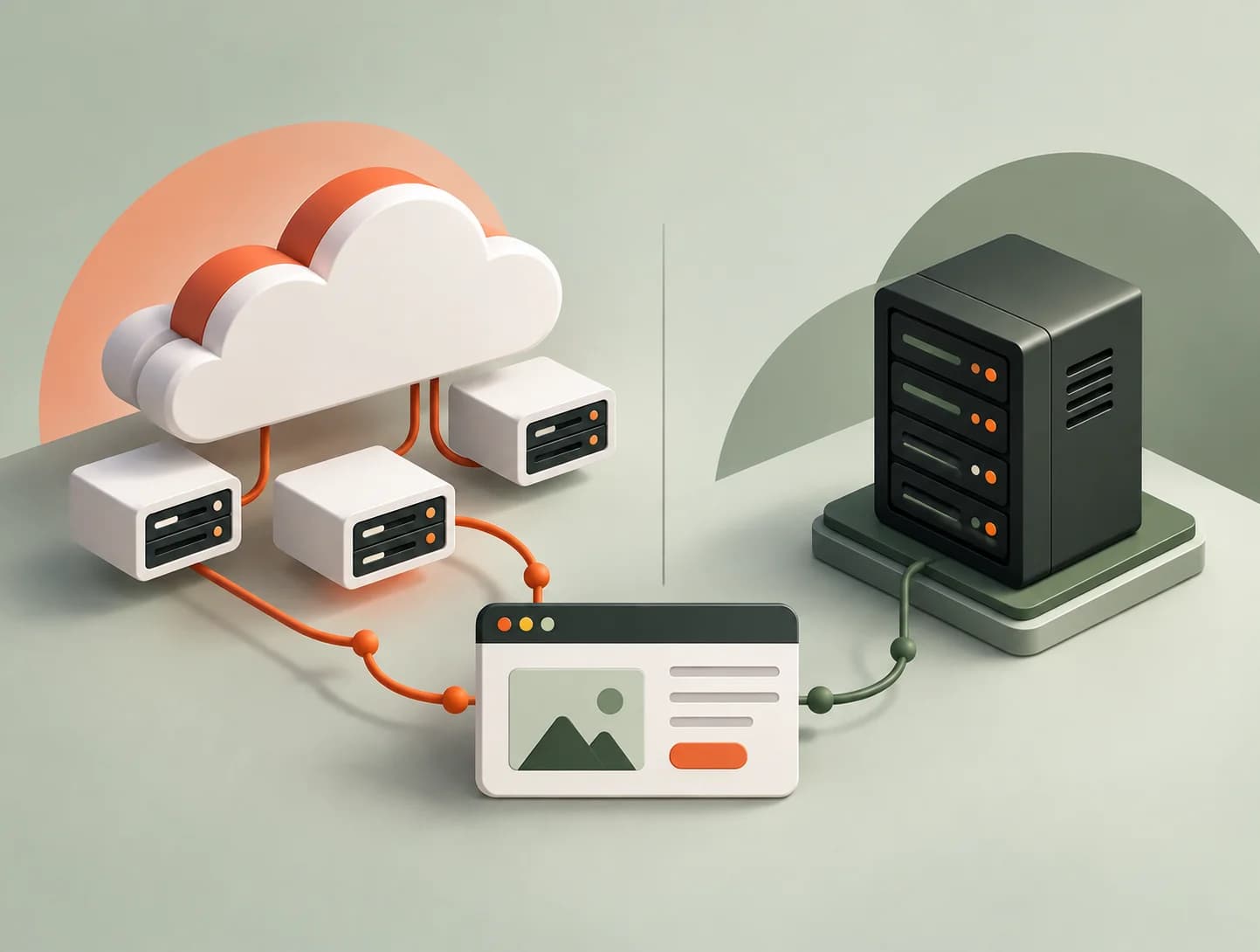
Instead of your website living on one physical machine, it lives on a massive, interconnected network of servers (a "cloud" like AWS, Google Cloud, or Azure).
The Advantages of Cloud Hosting:
- High Availability (No Downtime): If one physical server in the cloud cluster burns out, the cloud infrastructure instantly and automatically moves your website to a healthy server. Your website never goes offline.
- Infinite Scalability: If you run a Diwali sale and traffic spikes 1000%, Cloud Hosting can automatically allocate more CPU and RAM to your website in real-time to handle the load, and then scale back down when the sale ends.
- Data Redundancy: Your data is constantly mirrored across multiple physical hard drives.
The Disadvantages of Cloud Hosting:
- Unpredictable Costs: Cloud hosting usually charges on a "pay-as-you-go" model. If you get a massive spike in traffic, your monthly bill will spike as well. If not configured correctly by a DevOps engineer, cloud bills can become astronomically expensive.
- Technical Complexity: Managing an AWS or Azure cloud environment requires highly specialized engineering knowledge. It is not designed for beginners.
Which Architecture Should You Choose?
Choose VPS if:
- You run an internal company portal, a B2B staging environment, or a consistent-traffic blog where 99.9% uptime is not a life-or-death metric.
- You need strict, predictable monthly billing with absolutely no surprises.
- You have a capable system administrator but do not have the budget for complex DevOps architecture.
Choose Cloud Hosting if:
- You run a high-revenue E-Commerce store (like Comez, Magento, or custom Node.js apps). If your site crashing for one hour costs you ₹50,000 in lost sales, you must use Cloud Hosting.
- Your traffic is highly variable (e.g., you get huge spikes during specific marketing campaigns).
- You require enterprise-grade redundancy and automatic disaster recovery.
Deploying enterprise web applications requires serious infrastructure. Nutz specializes in designing, migrating, and managing secure, auto-scaling Cloud and VPS architectures on AWS and modern platforms. Explore our DevOps services.
Related work
View Clotricks web app case studyAbout the Author
Nutz
Design & Development Team
We share insights on design, development and building digital products from our studio in Erode, Tamil Nadu.
Work with usRelated SaaS product
Built by Nutz in Erode
Explore SaaS products we design and ship.