The End of the Chatbot Era? Why AI Agents Could Change Software Forever

Nutz
2026-11-24
The era of typing prompts into chatbots is evolving. Discover how AI agents and agentic workflows are changing software architecture and business automation.
For the past few years, the dominant interface for Artificial Intelligence has been the chatbot. You type a prompt, and the AI generates text, code, or an image.
But chatting with an AI is ultimately a manual process. It requires a human to guide it every step of the way. As we look toward the future of software, a massive paradigm shift is occurring: we are moving from chatbots that talk to AI Agents that do.
The era of the simple chatbot is ending, making way for the era of Agentic Software. Here is why AI agents are fundamentally different, and how they could change the way we interact with computers forever.
The Evolution of the Digital Interface
To understand why AI agents are revolutionary, look at how human-computer interaction has evolved:
- Search: Type a keyword → Get a list of links.
- Websites/Apps: Click menus and buttons → Retrieve information from a database.
- Chatbots (LLMs): Type a conversational prompt → Get a generated text response.
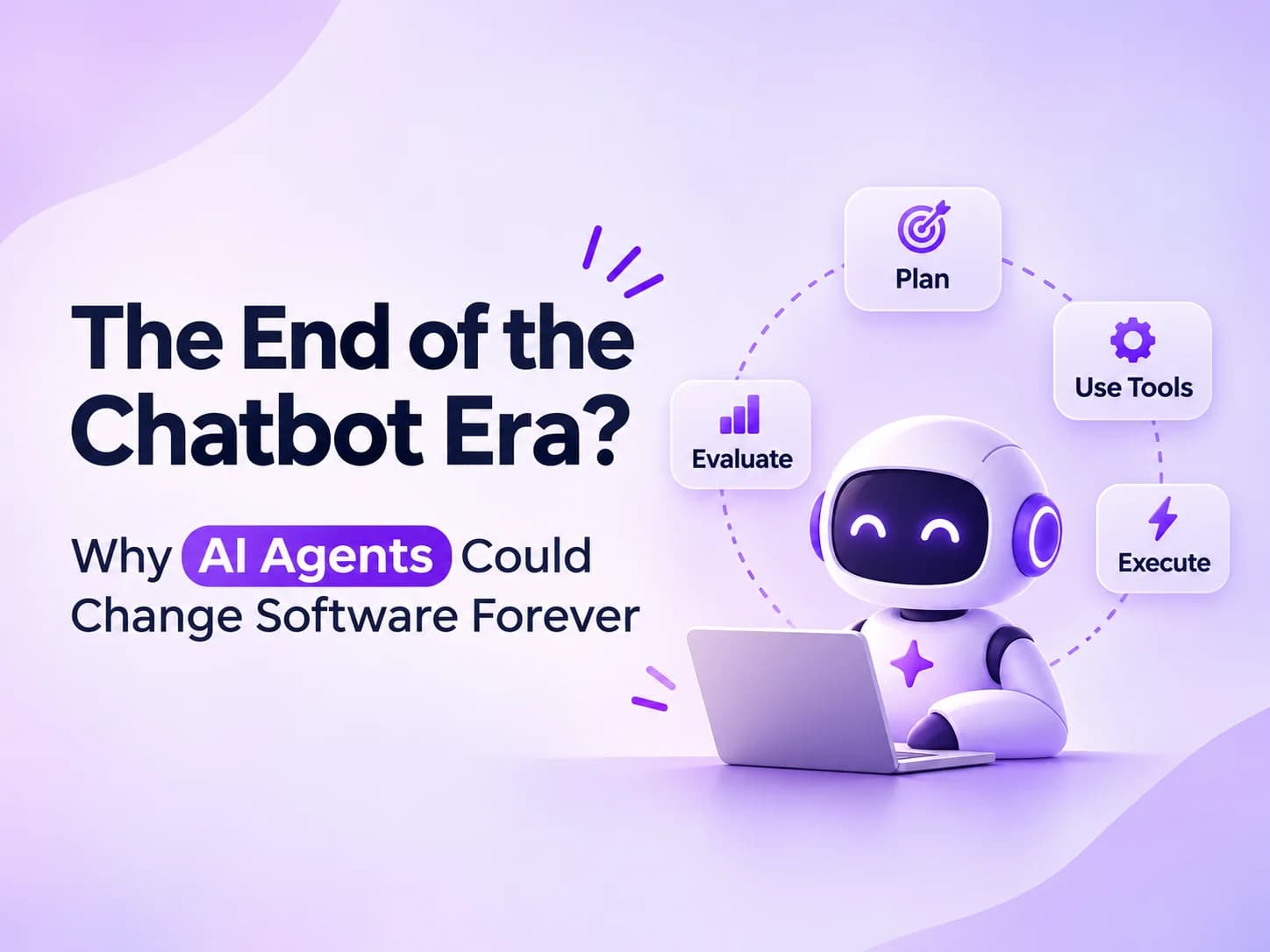
- AI Agents: State an intent → The system plans, uses tools, and executes the task autonomously.
What Makes an AI Agent Different from a Chatbot?
A chatbot is a conversational tool. An AI Agent is an autonomous system.
To be considered a true AI agent, the system typically possesses:
- Goals: It is given an objective (e.g., “Research our top 3 competitors and create a pricing comparison matrix in Excel”).
- Tools: It has access to external APIs, calculators, web browsers, or internal databases.
- Memory/State: It remembers past interactions and can maintain context over long, multi-step workflows.
- Planning & Decision-Making: It breaks the large goal down into a step-by-step plan.
- Execution & Feedback: It attempts a step, evaluates if it worked (e.g., “Did the web scrape return data?”), and adjusts its strategy if it failed.
How Agents Change Software UX
Traditional software requires a human to act as the router.
Traditional UX: Human → Clicks UI buttons → Software triggers API → Database updates.
With agentic software, the human states the goal, and the AI handles the routing.
Agentic UX: Human states intent → Agent plans the workflow → Agent calls tools/APIs → Systems update.
This does not mean traditional User Interfaces (UIs) will disappear. We will still need buttons and dashboards for oversight and simple tasks. However, complex, multi-step operations will increasingly be abstracted behind agentic workflows.
Where Are AI Agents Genuinely Useful?
AI agents excel in environments with high data volume and complex, tedious workflows:
- Customer Support & Resolution: Not just answering FAQs, but actually accessing the billing API to process a refund autonomously.
- Sales Qualification: Researching an inbound lead, scoring them, and drafting a hyper-personalized outreach email.
- Software Development: Acting as junior developers that can read GitHub issues, write code, run tests, and open Pull Requests.
- Data Research: Scanning hundreds of PDFs or financial reports to extract specific metrics into structured databases.
The Risks of Autonomous Systems
While agents are powerful, granting them autonomy introduces severe risks:
- Irreversible Actions: You do not want an AI agent accidentally executing a massive financial trade or deleting a production database because it misunderstood a prompt.
- Security & Permissions: Agents require access to APIs. If an agent is compromised via prompt injection, it could leak sensitive internal data.
- Hallucinations in Workflows: If an agent hallucinates a fact in step 1 of a 10-step plan, the entire execution will fail catastrophically.
The Future Architecture: Agent + LLM + Decision Model
To mitigate these risks, the future of agentic software relies on a pipeline of specialized intelligence components.
Instead of one massive LLM doing everything, robust systems will use:
- The LLM: For reasoning, planning, and language generation.
- Decision Models (like Jev or Laya): Fast, non-autoregressive models used as guardrails to instantly classify intents and ensure the agent stays on track.
- Deterministic Code: Traditional business rules and strict APIs that execute the final actions securely.
Will Agents Replace Software?
AI agents will not replace software; they will become a new, deeply integrated interface layer over software.
The software applications that survive the next decade will be those that expose their functionality not just to humans clicking buttons, but via clean APIs designed specifically for AI agents to navigate and execute. We are moving toward a world where humans design the systems, and intelligent agents do the heavy lifting.
Related work
View Clotricks web app case studyAbout the Author
Nutz
Design & Development Team
We share insights on design, development and building digital products from our studio in Erode, Tamil Nadu.
Work with usRelated SaaS product
Built by Nutz in Erode
Explore SaaS products we design and ship.