Can AI Run a Business? Inside the Rise of Autonomous Companies

Nutz
2026-11-04
What happens when AI agents take over business workflows? Explore the architecture, risks, and reality of autonomous companies and AI employees.
What if a company could operate 24 hours a day, executing complex marketing campaigns, managing inventory, and closing customer support tickets, with AI handling much of the heavy lifting?
This is no longer purely science fiction. As we transition from simple conversational chatbots to goal-driven AI Agents, the concept of the “Autonomous Company” is becoming a serious architectural discussion in the tech industry.
Can an AI actually run a business? To answer this, we must look at the difference between an AI assistant and an AI employee, explore the architecture of autonomous workflows, and understand the deep limitations of machine intelligence.
From Assistants to Autonomous Agents
To understand the autonomous company, we need to define the evolution of AI tools:
- AI Assistant: You write the email, the AI checks the grammar. (Human driven).
- AI Agent: You say, “Resolve support tickets related to delayed shipping.” The agent logs into the helpdesk, reads the tickets, checks the shipping API, drafts responses, and issues refunds. (Goal driven).
- Multi-Agent System: An AI “Sales Agent” researches a lead, passes the data to an AI “Marketing Agent” to draft a custom pitch, which is verified by an AI “Review Agent” before sending. (System driven).
What Can (and Cannot) Be Automated?
What AI Agents Can Potentially Handle:
- Data Research & Qualification: Scoring inbound leads based on company size and industry.
- Tier 1 & 2 Customer Support: Reading policies and executing API commands (like updating an address).
- Routine Software Testing: Scanning code for bugs and automatically writing tests.
- Inventory Analysis: Reordering stock when database levels drop below a threshold.
What Remains Exclusively Human:
- Leadership & Strategy: AI cannot determine the overarching vision or ethical boundaries of a company.
- Trust & Relationships: Enterprise B2B sales require human connection, negotiation, and trust that a machine cannot replicate.
- Accountability: If an AI makes a catastrophic error, the human CEO is still legally and financially responsible.
- Strategic Ambiguity: AI thrives on clear rules. Business often requires navigating extreme uncertainty and shifting human emotions.
The Architecture of the Autonomous Company
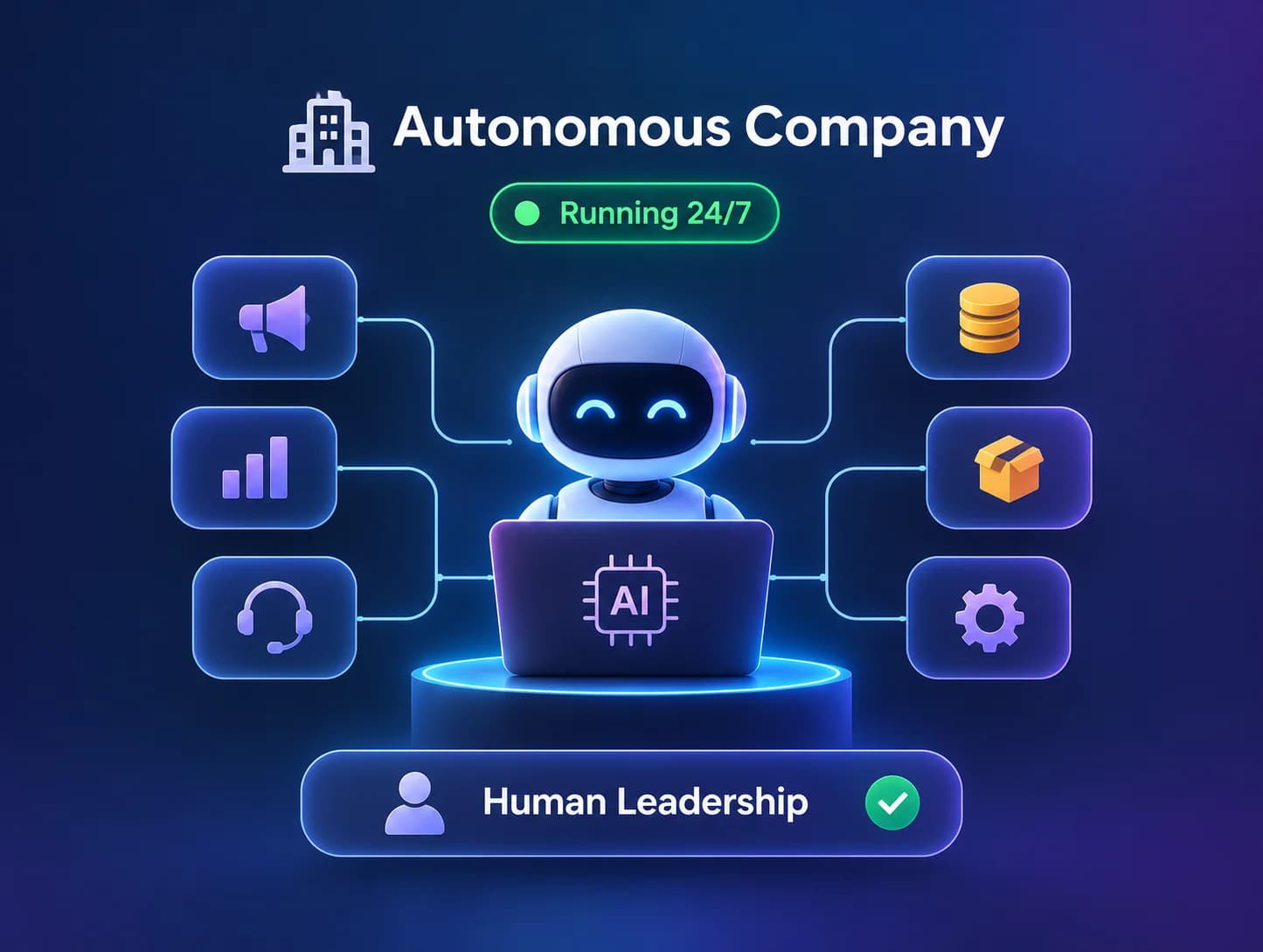
An autonomous company is not a single giant AI model running on a server. It is a highly structured software architecture where different types of intelligence work together.
The Hybrid Execution Stack:
- Human Leadership: Sets the business objectives and revenue goals.
- AI Orchestrator (LLM): Plans the overarching strategy and delegates tasks.
- Specialized AI Agents: Execute specific tasks (e.g., the Marketing Agent, the Finance Agent).
- Decision Models (like Jev or Laya): Fast, strictly typed models that act as guardrails, instantly classifying data to ensure the agents don't hallucinate.
- APIs and Deterministic Software: The agents interact with standard business software (like Shopify, Stripe, or a CRM) via strict APIs.
- Human Approval Gate: For any action involving large sums of money or permanent data deletion, the agent pauses and asks a human for a click of approval.
Three Scenarios for the Future
We can look at the future of business automation in three architectural scenarios:
Level 1: The AI-Assisted Company (Current State)
Humans do the core work. AI is used as a tool to speed up typing, brainstorming, and data sorting.
Level 2: AI-Operated Workflows (Emerging)
Humans define the workflows. AI agents execute long, multi-step processes autonomously but pause for human review before finalizing critical actions.
Level 3: Highly Autonomous Business Operations (Future)
AI agents manage entire departments (like lead generation or tier-1 support) communicating with each other continuously. Humans act purely as strategic supervisors and relationship managers.
The Severe Risks of Autonomy
Handing the keys of your business to AI agents introduces massive enterprise risks:
- Cascading Failures: If a Finance Agent hallucinates an invoice amount and automatically pays it via API, the money is gone.
- Automation Bias: Humans become so accustomed to the AI being right that they blindly approve errors without actually checking the work.
- Prompt Injection and Security: If an external bad actor sends a cleverly crafted email designed to confuse your AI Support Agent, it could trick the agent into revealing sensitive customer data.
The Verdict
Could one person operate a company with 100 AI agents? Theoretically, for very specific, purely digital arbitrage businesses, yes. But for companies building physical products, offering high-end services, or managing complex enterprise software, humans are not going anywhere.
The future of the enterprise is not humans versus AI. The future is humans designing highly secure, API-driven software systems where different forms of intelligence—both human and artificial—work together to scale output exponentially.
Looking to modernize your business operations? Nutz builds robust software systems, custom e-commerce platforms, and API integrations designed for the future of automation.
Related work
View Clotricks web app case studyAbout the Author
Nutz
Design & Development Team
We share insights on design, development and building digital products from our studio in Erode, Tamil Nadu.
Work with usRelated SaaS product
Built by Nutz in Erode
Explore SaaS products we design and ship.