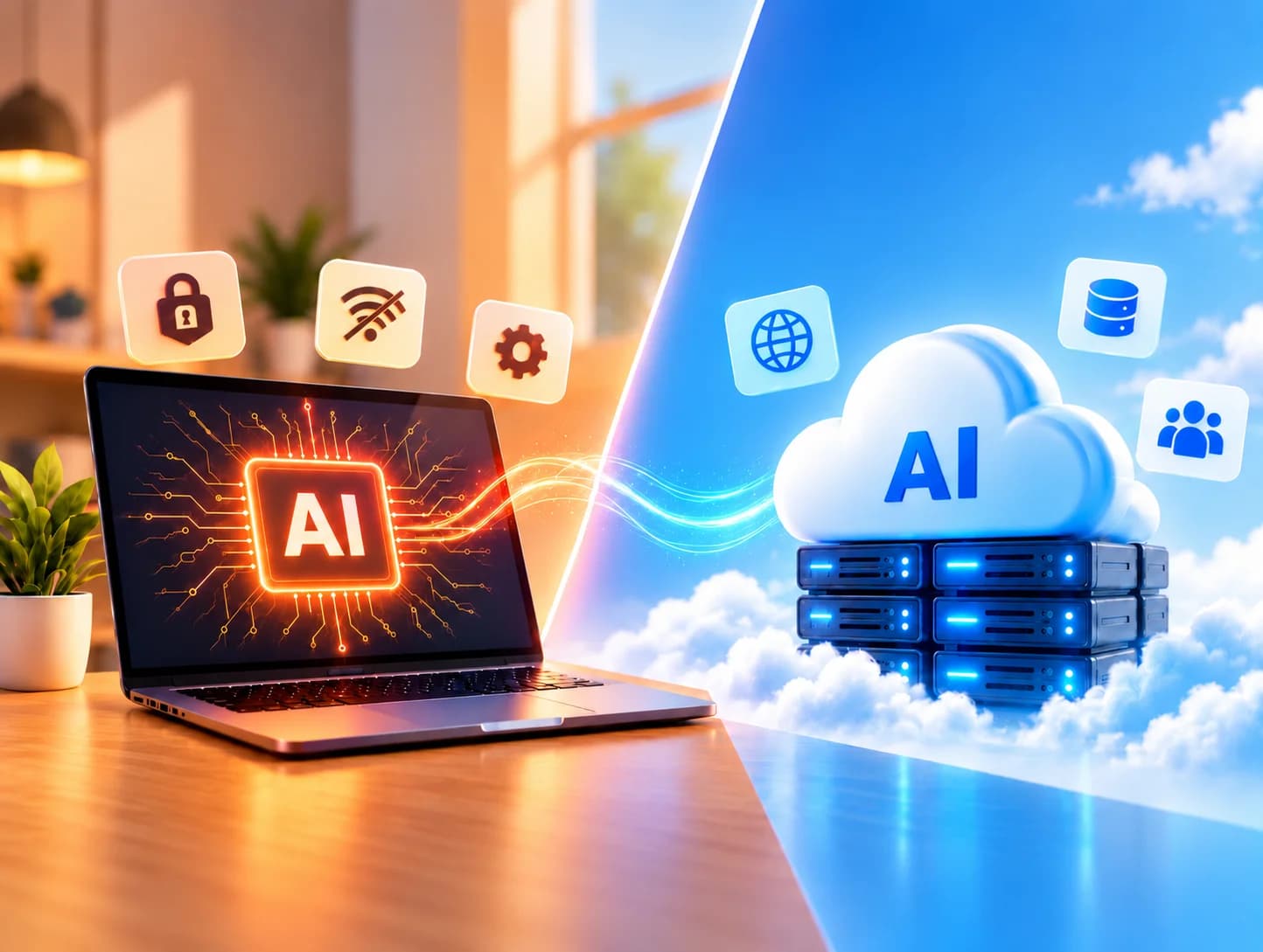
As AI inference costs drop, the economics of automation change. Explore the financial tipping point of AI vs human labor and what it means for the future of work.
In boardrooms across the world, executives are running the math on a profound economic question: At what point does it become cheaper to hire an AI agent than a human employee?
The media often frames this as a dystopian science fiction scenario where AI inevitably and instantly replaces humanity. However, the reality of business operations is far more complex.
Comparing the cost of an "AI token" directly to an "employee salary" is fundamentally misleading. To understand the future of work, we must investigate the actual economic conditions under which a business might automate a human role.
Calculating the True Cost of Human Labor
When a business hires a human, the cost is rarely just the monthly salary. The true cost includes:
- Direct Compensation: Base salary, bonuses, and mandatory benefits (PF, healthcare).
- Acquisition & Training: Recruitment fees, onboarding time, and ongoing training.
- Infrastructure: Office space, laptops, software licenses, and HR management.
- Friction: Turnover, sick leave, downtime, and interpersonal coordination.
For a mid-level data processor in India, a ₹40,000 monthly salary might actually cost the company ₹60,000+ per month when all overhead is factored in.
Calculating the True Cost of an AI System
Conversely, the cost of an AI system is never just the API fee per generation. The true cost of enterprise AI includes:
- Model Inference: The direct cost of computing the AI's response (which is dropping rapidly).
- Infrastructure & Software: Cloud hosting, API gateways, and the surrounding application architecture.
- Integration & Maintenance: Developer salaries to connect the AI to the company’s CRM, databases, and secure networks.
- Supervision & Error Costs: When an AI hallucinates a refund to a customer, the business eats the financial loss. A human must still be employed to review the AI’s output and handle edge cases.
The Tipping Point: Cost Per Successful Task
Businesses do not automate based on the cost of intelligence; they automate based on the Cost Per Successful Task.
Scenario: Tier 1 Customer Support
Imagine a retail company receiving 10,000 "Where is my order?" queries a month.
- Human Cost: Hiring 10 support agents might cost ₹3,00,000/month.
- AI Cost: An AI agent integrated into the database can answer these queries instantly for roughly ₹15,000 in API costs, plus ₹50,000 in software maintenance.
In this scenario, the AI is vastly cheaper per successful task. The business will likely automate Tier 1 support immediately.
Scenario: High-Stakes Legal Document Review
A law firm needs to review 500 contracts for compliance risks.
- Human Cost: Junior lawyers cost ₹5,00,000/month but guarantee a 99.9% accuracy rate with professional liability insurance.
- AI Cost: The AI can scan the documents for ₹5,000, but has a 4% hallucination rate.
If the AI misses a critical liability clause, the lawsuit could cost the firm ₹5 Crores. Because the Cost of Errors is so high, AI remains an augmentation tool here, not a replacement for human labor.
Why Cheap AI Does Not Automatically Mean Mass Unemployment
According to recent evidence from the International Labour Organization (ILO) and the World Economic Forum (WEF), large-scale job displacement has remained limited even as AI adoption accelerates.
Why? Because human desires are infinite.
If AI makes legal services 10x cheaper, we won't necessarily fire 90% of lawyers. Instead, the demand for legal services will skyrocket because millions of small businesses can finally afford them. This creates more work, just of a different nature.
Similarly, if AI allows a software development team to write code 5x faster, the company does not fire 80% of its developers. It builds 5x more software products.
The Future of Organizational Redesign
When AI becomes significantly cheaper than human labor for repetitive, structured, and digital tasks, businesses will not just swap a human for a bot. They will completely redesign the organization.
We are moving toward a structure where humans act as managers of AI systems—setting strategy, managing client relationships, verifying outputs, and handling the complex, ambiguous problems that machines still cannot understand.
Preparing your business for the AI transition requires robust software architecture, not just chatbots. Nutz helps enterprises build secure, scalable AI automations. Explore our solutions here.
Related work
View Clotricks web app case studyAbout the Author

Nutz
Design & Development Team
We share insights on design, development and building digital products from our studio in Erode, Tamil Nadu.
Work with usRelated SaaS product
Built by Nutz in Erode
Explore SaaS products we design and ship.